

AEO vs SEO: What’s the Difference, and Do You Need Both?
Clients ask me about AEO versus SEO all the time. The question I want to help them answer is practical: what should they change, and where is their marketing budget best spent?
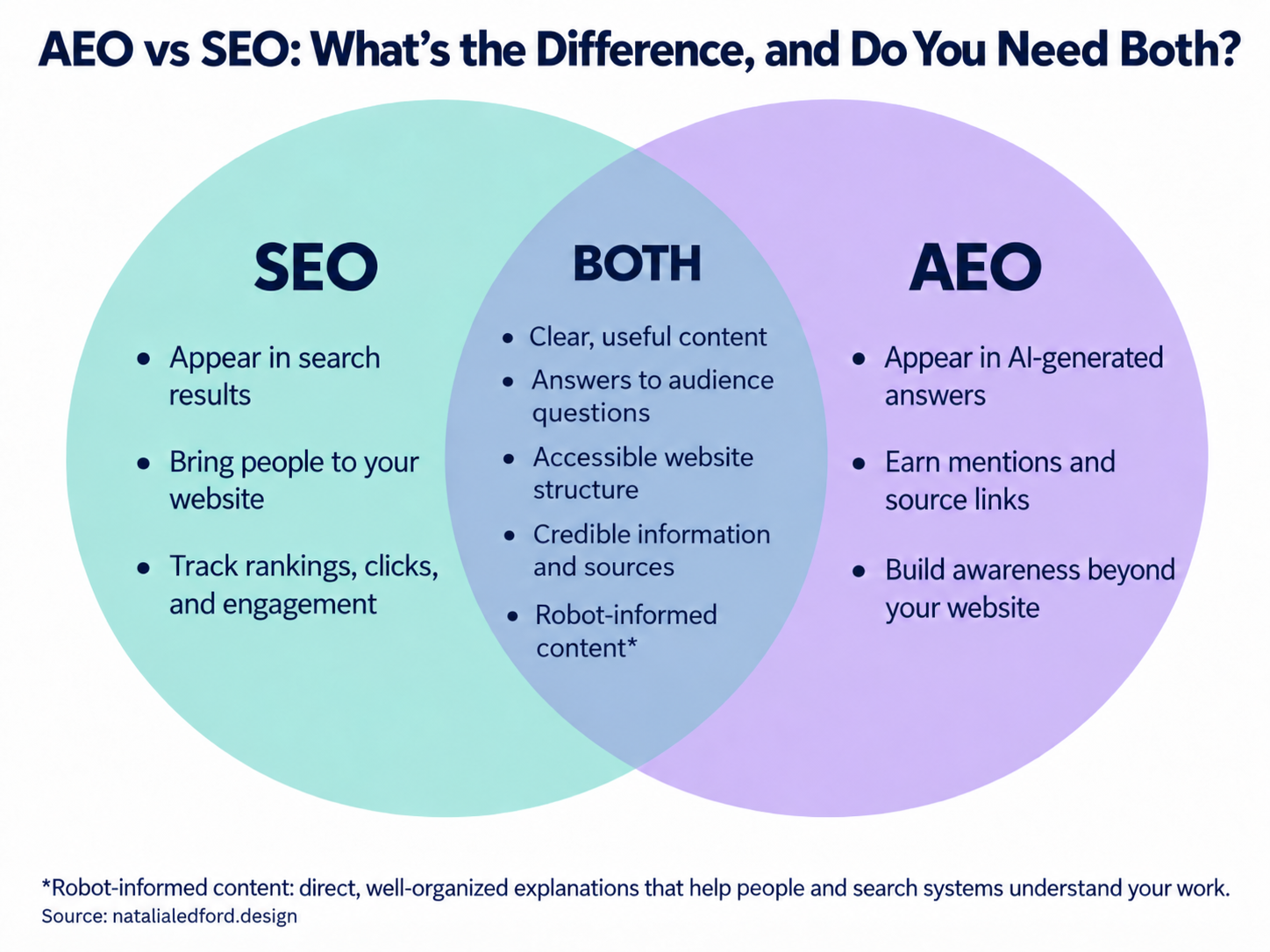
My personal opinion: optimize for AEO and SEO at the same time. They have different aims, but there is enough overlap in the work that I see a net benefit for websites.
I also think business owners and nonprofit leaders should ignore the hype that AEO is taking over SEO and websites will stop mattering. The results I see in my client work give me reasons to invest in both. Which results matter most depends on what your organization needs to accomplish.
What is SEO?
SEO helps your website appear when people search for information, products, or services related to your work.
It involves making pages accessible to search engines, publishing useful content, organizing information clearly, and helping people navigate the site. Google’s SEO Starter Guide describes SEO as helping search engines understand content and helping users find a site and decide whether to visit.
For a mission-driven organization, that could mean appearing when someone searches for housing assistance, a ballot measure explanation, or research on an issue. The goal connects discovery to something meaningful: a donation, an inquiry, participation, or a better-informed decision.
What is AEO?
AEO is a term used for work intended to improve visibility in answer-based search experiences, including AI-generated answers.
Those experiences include Google AI Overviews and AI Mode, as well as search-enabled responses in tools such as ChatGPT and Perplexity. Visibility can take several forms: a link to your article, a mention of your organization, or inclusion in a comparison.
These are different outcomes. A citation links to a source; a mention may name an organization without linking to it. Neither automatically produces a website visit or an inquiry.
What is the main difference between AEO and SEO?
The main difference is the visibility you are examining: SEO looks at search discovery broadly, while AEO focuses on inclusion in answers.
The boundaries are increasingly blurred because search results can contain both website links and generated answers.
QuestionSEO emphasisAEO emphasisWhere does visibility appear?Search results, including links and other search featuresDirect answers, summaries, citations, and recommendationsWhat content matters?Pages that answer what someone is searching forInformation that helps answer relevant questions accuratelyWhat do you measure?Search appearances, clicks, rankings, and useful actionsMentions, citations, answer accuracy, and resulting visits or inquiriesWhat do they share?Accessible pages, useful information, and clear organizationMany of the same foundations
A page appearing in search results and an organization appearing in an answer are related opportunities. They need separate observation because one does not tell you everything about the other.
Does AEO replace SEO?
No. Foundational SEO remains relevant to visibility in AI-powered search.
Google explicitly states that its AI search features rely on its core search ranking and quality systems. In its guide to optimizing for generative AI search, Google treats optimization for those experiences as part of SEO.
That guidance applies to Google’s systems; it should not be treated as a complete description of every AI platform. In my client work, I approach SEO and AEO as connected parts of discoverability. I want a clear, useful website and an understanding of how different search and AI platforms represent the organization.
The claim that websites will no longer matter overlooks what many organizations need people to do: explore information, evaluate a service, donate, sign up, or get in touch. If those actions happen on your website, getting people there still matters.
Why should organizations care about appearing in AI answers?
An answer can shape someone’s understanding of your organization before they visit your website.
For a nonprofit, that might mean whether its work is accurately explained. For an advocacy campaign, it could mean whether someone encounters a reliable account of what a proposal does. For a service provider, it might mean appearing when a prospective client compares options.
Pew Research Center’s analysis of browsing data from 900 U.S. adults found that traditional search links received clicks in 8% of Google visits with an AI summary, compared with 15% without one. Links within the summaries received clicks in just 1% of visits with a summary.
Those findings describe a particular study period, not every audience or search today. They illustrate why visibility and website traffic need to be considered separately.
What have I seen when using SEO and AEO together for clients?
In my client work, AEO has helped information appear in AI answers, while traditional organic search has continued to bring valuable visits and engagement to the website.
I have helped a client take a brand-new domain to more than 100 recorded mentions across major AI search tools within a month. In a recent SEO case, a client’s website reached the first page of Google for a target search within about three months.
These are examples from my work, not timelines I promise every client. And an AI mention and a Google ranking measure different things. The important question is what happens after that visibility.
For the educational client I am referring to, AI visibility helps get their information in front of people searching the topic. That is valuable to them even when someone reads the answer without visiting the website. But those AI appearances have not translated into the same volume of website visits that we see from organic search.
The website engagement data gives us another reason to keep investing in SEO. In this client’s reporting, visitors arriving through organic search spent 10 times longer on the website than visitors arriving through paid ads.
That is a finding from this client’s data, not a claim that organic search always performs 10 times better. It also measures time on the website, not donations, sales, or sign-ups. Still, for an educational website that wants people to spend time learning, it is a meaningful result.
My take: I am not going to tell a client to abandon a channel bringing people to their website and keeping them engaged because another channel is getting more attention in the marketing industry.
Is AI visibility valuable if it does not lead to a website visit?
Yes, if reaching people with your information is itself an important goal.
For an educational organization, a clear and accurate AI answer can help someone understand the topic. For a nonprofit or advocacy group, it can introduce people to its work or explain an issue it wants the public to understand. That can support awareness even without a click.
This is why I want clients to define success before judging either channel. If your goal is public education, having your information accurately represented in an answer can be useful. If you need people to compare your services, read detailed resources, register, or contact you, website visits and what people do during those visits remain essential.
AEO can support awareness, but awareness alone may not deliver everything your organization needs. Keep SEO best practices in place when your goals depend on people finding and using your website.
What is “robot-informed content”?
“Robot-informed content” is my term for structured sections that clearly answer common search and AI questions in simple, neutral language.
It gives a website an explicit information layer: what the organization does, whom it serves, how its work functions, and what evidence supports its claims. That layer can take the form of FAQs, articles, glossaries, or explanatory sections on a landing page.
This is where my work with clients connects content strategy to brand and web design. I want the website to give people a reason to care and a clear explanation of what the organization actually does. A brand needs emotion, personality, and a reason for people to care. A powerful headline can establish that connection, while a clear explanation underneath makes the work understandable.
For example, an illustrative campaign headline might say:
“Every community deserves a voice.”
A robot-informed section could then answer:
What does this campaign do?
“This campaign advocates for an independent redistricting commission to change how legislative district boundaries are drawn.”
The second statement gives the mission a concrete meaning. Readers can understand it immediately, and search systems have a clearer description to work with.
Does robot-informed content mean writing everything like an FAQ?
No. Question-and-answer sections are one useful format; the larger goal is clear, complete explanation.
Some subjects need a story, a diagram, a detailed guide, or a case study. A question-led section works well when readers need a specific answer quickly.
My preferred structure is:
- Use a heading that identifies the reader’s question.
- Give a direct answer immediately.
- Explain the details, limits, and implications.
- Add evidence or a concrete example.
- Link to related information when it helps.
This is an editorial method, not a guaranteed citation technique. Google’s generative AI guidance says there is no requirement to divide content into tiny chunks or write in a special style for AI. The purpose is to make the explanation more useful.
How can you make content clear without making it generic?
Combine direct explanations with expertise, evidence, and a point of view that your organization can substantiate.
A well-formatted page still needs something worthwhile to say. Useful additions include original research, a case study, an expert interview, or an explanation grounded in firsthand experience.
Google’s people-first content guidance asks creators to consider whether their work provides original information, substantial explanation, and value beyond simply rewriting existing sources.
For a mission-driven organization, neutral explanation also helps readers distinguish a proposal’s documented effects from the organization’s arguments for supporting it. Clear attribution strengthens both understanding and credibility.
Do you need to rebuild your website for AI search?
You may need to improve your website, but appearing in Google’s AI answers does not require a separate version built for AI.
Google’s AI features documentation says there is no special AI code or text file required. The useful starting points are familiar: pages that search engines can access, clear written information, links that help readers explore related topics, and a website that is easy to use.
Before commissioning a rebuild, ask what specific problem it would solve. Missing explanations may call for better content; pages that cannot be accessed may need a technical fix.
How should you measure SEO and AEO performance?
Measure visibility, website visits, and meaningful engagement separately, then connect each to your organization’s goals.
For SEO, track how often your pages appear, how many people visit, what they searched for, and what they do once they arrive. For AEO, track whether your organization is mentioned, whether your pages are linked as sources, and whether your information is represented accurately.
Google includes traffic from its AI search features in Search Console, its website search reporting tool. That is different from measuring visits from standalone chatbot services.
How much should you trust AEO tool scores?
Treat them as useful indicators of what a tool observed, rather than a complete measure of your visibility or audience.
This field is still developing. A visibility score depends on which questions the tool checks, which platforms it includes, and how it counts the answers. It does not tell you exactly how many real people saw your organization or visited because of it.
Ahrefs’ AI visibility guide acknowledges limitations including test prompts rather than actual user query logs, varying AI responses, and difficulty connecting mentions to conversions. Its measurement methodology also explains how its own prompt sets are constructed.
We can identify some visits from chatbots when the source is recorded. But that does not give us a complete account of AI’s influence: someone may learn about an organization in an answer and visit later through another route. Google reporting has limits too, but I would not give an emerging AEO score the same weight as directly observed website visits and engagement.
My advice to clients is to take AEO scores with a grain of salt. Ask what was measured, keep the checks consistent, and judge the findings alongside what is happening on your website.
How do I help clients think through five common AEO misconceptions?
I bring the discussion back to what the organization needs, what the evidence supports, and what the proposed work will actually improve.
These are five assumptions I would challenge when evaluating an SEO and AEO plan with a client.
1. Does investing in AEO mean we should stop doing SEO?
No. Treating the two as competing investments can distract from work that supports both.
My advice to clients is to ask what an AEO proposal adds to their existing strategy. Does it identify unanswered audience questions, check how AI describes their work, or improve useful content? Those are concrete reasons to invest. A new label alone is not.
2. Will publishing more articles make us more visible?
More articles are useful when they answer distinct questions well; publishing volume alone is not a strategy.
I would rather help a client build a focused group of useful pages than fill a blog with slightly different versions of the same explanation. Each article should have a clear job: explain something, help someone compare options, or support a decision.
Google’s generative AI search guidance also cautions against creating pages for every possible query variation primarily to manipulate visibility.
3. Do we need to make our website sound more robotic?
No. Clear explanations can coexist with warmth, conviction, and a distinctive voice.
That is the purpose of my robot-informed content approach. I want clients to retain the language that makes their work meaningful while adding direct explanations where readers need them. A homepage can move someone emotionally and still explain whom the organization serves, how its work functions, and what to do next.
4. If AI mentions us, does that mean the marketing is working?
A mention can support awareness, but whether it counts as success depends on your goal.
For my educational client, getting accurate information into an answer has value. A business that needs inquiries or sales also needs to know whether people are visiting and taking action. Being named, accurately described, cited, visited, and contacted are different outcomes; reporting should make that clear.
5. Can an agency guarantee that AI will recommend us?
A guarantee deserves scrutiny: a provider should explain what it can control and how it will measure progress.
My advice is to look for specific work and transparent reporting. What will change on your website? Which audience questions will be checked? How will success be judged? Google itself says that meeting its requirements does not guarantee a page will be indexed or shown in its AI features.
The service should be understandable enough that you can explain what you are buying to your own team.
Where should an organization start with SEO and AEO?
Start with the questions your audience needs answered and check whether your website answers them clearly.
I organize this work into three connected areas:
- Technical: Can search systems access and understand the important pages?
- On your website: Does the content clearly explain the organization’s work and answer relevant questions?
- Beyond your website: Do credible external sources provide evidence, context, or accurate descriptions of that work?
Robot-informed content belongs in that on-site layer. It turns an implied message into an explicit explanation while preserving the human qualities that make a brand memorable.
My recommendation is to optimize for both SEO and AEO through this connected approach, then give each channel the weight your goals justify. AEO can help your information reach people inside an answer. SEO can help bring people to a website where they can learn more and take the next step.
If your website communicates a compelling mission but leaves basic questions unanswered, improving that information layer is a practical place to begin. An SEO and AEO assessment can identify those gaps, prioritize the topics that matter, and connect discoverability to your organization’s goals.
Is your mission-driven organization ready for AI search?
Alistar protocolos legales de manera rápida, fácil y sin errores con Proto.





.svg)